min read
March 13, 2026
The Step-By-Step Guide to Calculating Your Office Pantry Budget
We’re going to share with you our not-so-secret, step-by-step formula for calculating your office pantry budget.

In 2026, workplace leaders are focused on how to create thoughtfully managed office pantry programs that boost performance, support morale, and make the in-office experience worth coming in for. Without an office food and beverage program, employees can spend $50+ per day just to be in the office. At the same time, companies lose an estimated 2.4 billion hours of productivity each year as employees leave the office for coffee, snacks, and quick food runs.
An office pantry program is one of the few workplace benefits that solves both challenges at once. By providing convenient access to snacks, beverages, and coffee in the office, companies help offset the everyday costs of coming into work while also keeping employees energized, focused, and present throughout the day.
But delivering a high-quality office experience while maintaining financial discipline is where many workplace teams get stuck. Leaders want to create a great office experience, but they also need to ensure the program stays within budget and scales across locations.
The key is approaching office pantry budget planning from the bottom up. Instead of guessing a monthly number, the most effective workplace leaders build their office snack budget using foundational inputs like employee-level spend, daily attendance, service expectations, and delivery cadence. When you start with these data points, you can design a managed snack program that supports both employee experience and financial predictability.
Below, we’ll walk through a simple, step-by-step formula for calculating your office pantry budget—so you can create a program that works for your employees and your budget.
Step 1: Estimate Your Office Headcount
Start by estimating how many employees are typically in the office each day. This number doesn’t need to be exact, but it forms the foundation of your pantry budget and helps guide ordering, restocks, and deliveries.
If you’re unsure about your attendance patterns, start by looking at:
- Badge or office attendance data
- Team in-office schedules
- A quick employee survey
- Check out this Office Busyness Index to see peak days across industries and cities.
Understanding when people are actually in the office helps you plan pantry demand and avoid empty shelves or overspending.
Step 2: Set An Employee-Level Budget
Next, determine how much you want to spend per employee per day. This number helps translate your pantry goals into a predictable monthly budget. Based on Crafty’s experience managing national pantry programs across 400+ offices, most companies fall into one of three daily budget tiers:
- Essentials: $5 per employee per day
- Elevated: $7.50 per employee per day
- Premium: $10 per employee per day
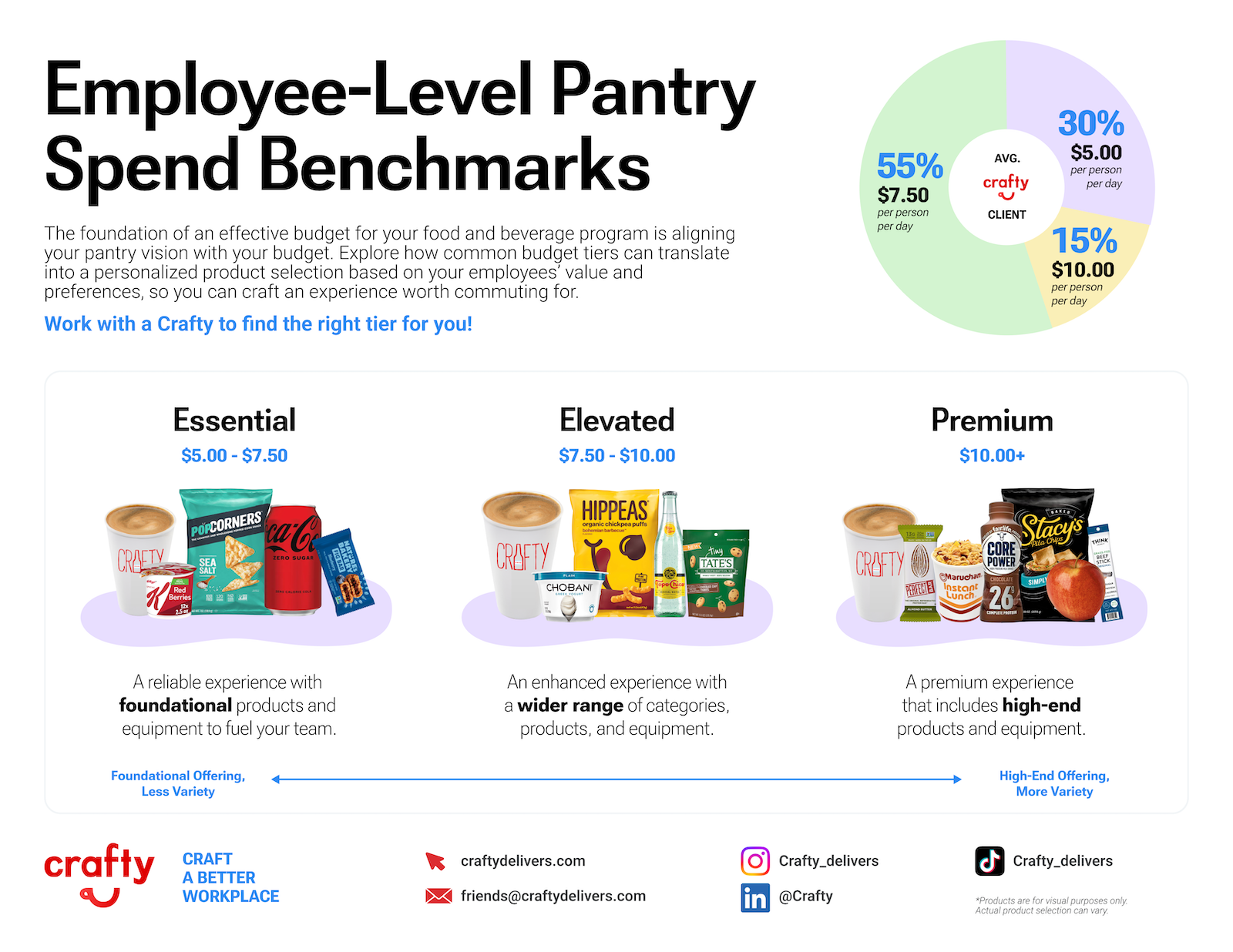
Your product mix will influence how far this budget goes. Lower-cost staples like chips, fruit, sparkling water, or oatmeal can stretch the budget further, while premium items like protein shakes, premium snack bars, or functional beverages may reduce the total number of items available per employee.
To build up to your estimated monthly pantry spend, multiply your daily employee-level budget by your estimated daily office attendance and the number of days your office is open.
For a deeper breakdown of what each budget tier typically includes, check out our guide to employee-level pantry spend tiers.
Step 3: Set Your Delivery Schedule
No one, and we repeat, no one wants to see empty shelves. Choosing the right delivery cadence is pivotal in maintaining a consistently stocked office snack station that aligns with your budget. Selecting the suitable delivery schedule ensures that your pantry is always well-supplied without excess inventory piling up, saving you money in the long run.
Here's what Crafty data suggests in terms of office snack delivery schedule:
- 2 deliveries/week for a $3k+ pantry spend (approx $375/delivery)
- 3 deliveries/week for a $7k+ pantry spend (approx $583/delivery)
- 4 deliveries/week for an $11k+ pantry spend (approx $687/delivery)
- 5 deliveries/week for a $15k+ pantry spend (approx $750/delivery)
As you scale across multiple offices, flexibility becomes especially important. Your headquarters in New York may require a very different delivery cadence than a smaller office in Dallas or Denver. When budgeting, it’s critical to account for each office’s unique attendance patterns, consumption habits, and space constraints. Building your budget around these differences will make execution much smoother, especially if you have real-time budget tracking by location to keep track along the way.
Step 4: Find the Right Managed Snack Service
Once you’ve built your budget and delivery cadence, the next question is how much operational support your office actually needs to run the program.
Some teams prefer to stay hands-on, while others want to offload pantry management entirely. The right approach typically falls into one of three levels depending on how much time your team can realistically dedicate to managing the pantry.
- Occasional snack deliveries: You primarily need coffee and snack deliveries to keep the pantry stocked, and your internal team is comfortable handling the operational work such as stocking shelves, organizing products, and keeping equipment running.
- Weekly pantry support: You want a managed snack service that delivers to your office and helps handle key operational tasks during those visits. This can include stocking snacks, refilling coffee machines, and light inventory management, while your team manages the pantry between deliveries.
- Daily, full-service pantry management: You need full-service pantry management with consistent on-site support. This approach takes pantry operations completely off your plate so your workplace team can focus on higher-impact responsibilities.
Ultimately, the right level of support comes down to how you want your workplace team to spend their time. Some organizations prefer their office managers to stay closely involved in pantry operations, while others prioritize freeing up that time for employee experience, events, and broader workplace initiatives. Choosing the right level of support ensures your pantry program runs smoothly while staying aligned with your team’s priorities and capacity.
Step 5: Finalize Your Equipment
The final step is determining what equipment your pantry program needs. Equipment isn’t just a space or aesthetic decision; it’s also a major factor in how your pantry budget works.
Depending on your setup, equipment can be rented, purchased, or bundled into your pantry program. But beyond the upfront cost, equipment also determines the types of products that will automatically become part of your pantry lineup. Those products then factor directly into your cost per employee per day.
For example, your office coffee machine selection can influence your coffee product spend:
- Bean-to-cup coffee machines require whole coffee beans and routine refills
- Drip coffee brewers require fraction packs and filters
- Pod coffee machines require single-serve pods
Office water dispensers will also require specific products:
- Water filtration systems require regular filter replacements
- Sparkling water machines require CO₂ tanks
- Flavor or hydration stations may require BIB refills
Beyond coffee and hydration, most office pantries also require equipment to support storage and organization, such as:
- Refrigerators and cold storage for drinks, dairy, or fresh snacks
- Snack racks or shelving systems for dry goods
- Freezers for frozen meals or ice
- Microwaves or warming equipment
- Coffee accessories and condiment stations
When planning your pantry program, it’s important to consider how equipment choices will influence both ongoing product costs and your overall cost per employee per day. The right setup should support the experience you want to deliver while keeping your pantry budget predictable and sustainable.
The Challenge in Execution Without the Right Office Pantry Partner
As you start building your office pantry budget using the steps above, many workplace leaders discover that planning the budget is only the beginning. Executing it is where things get messy.
What looks straightforward on paper, snacks, drinks, coffee, and equipment, can quickly turn into a complicated operational puzzle when you’re managing multiple offices without the right support. Suddenly, workplace teams find themselves deep in the weeds:
- Having to choose between different vendors across every office OR a lackluster traditional provider
- Trying to keep a handle on all the moving parts between ordering, deliveries, stocking, etc.
- Digging through endless emails to find invoices, order summaries, or simply confirmation that you got what you paid for
- And that's just the tip of the iceberg
Instead of focusing on workplace experience, teams end up running a mini supply chain operation inside the office and are stuck between operational chaos on one side and inflexible programs on the other.
And that’s why top workplace teams are looking for a different approach, one that combines centralized budgeting, operational support, and service accountability across offices.
Because once you’ve built the right pantry budget, the next challenge is making sure you can actually run the program without it running you.
The Crafty Advantage: Visibility, Service, and Budget Control
Between our technology platform and our team of food service experts, Crafty helps organizations move beyond chaotic ordering, scattered vendors, and reactive budgeting. Instead, workplace leaders gain a centralized system that keeps pantry programs running efficiently while staying aligned with budget expectations.
Here’s what you can expect when you partner with Crafty:
- Reliable Service & Support: The Crafty Team is an extension of you, ensuring that your office pantry is consistently stocked, looks beautiful, and everything is working as promised.
- Visibility Into Daily Operations: Our platform provides transparency into your office operations across locations so you can see what’s being accomplished at any time.
- Automated Inventory Tools: Crafty's automated inventory tools take the hassle of ordering off your plate while preventing overstocking or shortages.
- Budget & Spending Transparency: Our budgeting tools offer transparency into your pantry expenses in real-time so you can make adjustments before problems arise.
- Real-Time Optimization: Stay informed about what products are popular and adjust your offerings based on employee preferences.
Conclusion
An office pantry program works best when it’s intentionally designed from the ground up. By aligning attendance patterns, employee-level spend, delivery cadence, operational support, and equipment choices, workplace teams can build a program that fits both their budget and their office experience goals. When those pieces come together, the pantry stops being an operational burden and becomes a reliable, scalable benefit that supports employees and keeps the workplace running smoothly.
Check out the full office pantry budget guide on how to build, maintain, and forecast budgets with confidence.
Related Resource

Blog
The Future of Office Snacking: Learnings from Expo West 2026
April 1, 2026



Blog
Global Snacks Are the New Pantry Must-Have
March 23, 2026

Blog
Data Bites: Most Popular High-Energy Office Snacks
March 18, 2026

Blog
How to Manage A Snack Service Without Burning Out Your Team
March 17, 2026

Blog
The Step-By-Step Guide to Calculating Your Office Pantry Budget
March 13, 2026